A Short History of Mail-In Voting in the United States
By Tobias Link
This week, I am highlighting the different ways people cast ballots in U.S. elections. Today’s post was written by my research assistant, Tobias Link, a student at Wheaton College. Enjoy!
Mail-in voting dates back to the 1860’s. During the Civil War, Union states were looking for ways to allow soldiers’ access to voting. By the time of the 1864 presidential election, 25 states had passed legislation allowing soldiers to absentee vote; some camps set up makeshift polling locations while others allowed soldiers to mail their ballots directly to their home state.[1] By the early 1900’s, certain states allowed civilians who were sick, traveling, or disabled to vote absentee.
The issue arose again during World War II, when millions of soldiers were fighting overseas during elections. Congress passed the Soldier Voting Act of 1942 to ensure American soldiers could vote absentee in federal elections while overseas. In 1986, absentee voting expanded with passage of the Uniformed and Overseas Citizens Absentee Voting Act (UOCAVA). This law required every state to allow active-duty military members and their families, marines, and overseas Americans to vote by mail.
In 1978, California became the first state to allow any voter access to mail in ballots, no excuse needed. Many states followed California’s lead: 29 states now offer some form of no-excuse mail-in voting. Oregon pioneered a further expansion of voting access: all-mail elections.[2] After testing the processes in a few elections, Oregon started permanent vote-by-mail for local elections in 1987, expanding mail-in voting to federal elections in 1996 and presidential elections in 2000. Other states followed. As of 2026, 8 states and Washington DC have instituted all-mail voting. [3]
The Growth of Mail-In Voting in the United States
Since 2020, there has been a strong upward trend in mail-in voting, spurred on mainly by COVID-19. In response to the pandemic, many states that had previously required voters to provide a reason to receive an absentee ballot adopted no-excuse mail-in voting, with some of them keeping those systems in place post-2020. In the 2016 presidential election, absentee and mail-in ballots accounted for 23.7% of all votes cast nationally. By 2020, more than two in five voters (43%) cast ballots through the mail.[4] Although mail-in voting rates declined after an all-time high in 2020, they remain well above their pre-COVID levels. In the 2022 general election, the percentage of total votes cast by mail dropped down to just under 32%, with another slight drop in 2024, down to 29% of votes being cast by mail.[5]
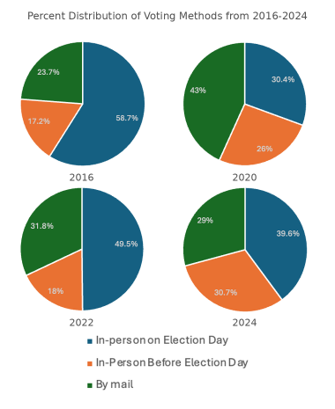
Voter turnout shows similar trends: turnout jumped from 2016 to 2020, and then declined slightly from 2020 to 2024. Several factors likely contributed to this increase in turnout: improvements in voter registration, heightened political polarization causing more extensive calls to vote, and the expansion of no-excuse mail-in voting. Recent research suggests a causal relationship between mail voting and voter turnout. In a 2023 study, McDonald et al. analyzed turnout data from two respected sources and found that states with a higher usage of mail voting also experienced higher voter turnout: “voter turnout across the states is consistently higher in every general election over the past decade in states with greater shares of overall ballots cast by mail.” [6] While the expansion of mail-in voting likely contributed to the increased voter turnout, it is difficult to isolate that as the only causal factor.
Growing Partisan Divides in Mail-In Voting and Confidence in Elections
At the same time mail voting was growing in popularity, it also became more divided along partisan lines, with Democratic voters being much more likely to use a mail-in ballot than Republicans. Once lauded as a method of expanding voter access and convenience, voting by mail became controversial and partisan. Republicans and Democrats began to differ not only in how they voted, but also in their confidence in election administration and their perception of mail-in voting. According to data from the MIT Election Data + Science Lab, until 2020, Democrats and Republicans voted by mail at very similar rates. Then in 2020, the percentage of Republicans voting by mail increased somewhat, while the percentage of Democrats skyrocketed. The partisan divide continued in 2024.
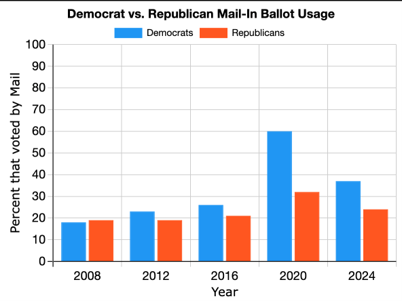
One factor that likely contributed to this divide was messaging from the Republican and Democratic leaders. In 2020, Democrats encouraged mail-in voting as a safe way to vote during to the pandemic, while Republican leaders tended to push back against expanded mail-in voting and question its security. Donald Trump opposed bills that would have expanded or supported mail-in voting and repeatedly criticized such efforts. In May of 2020, for example, Trump took to social media and claimed, “The United States cannot have all Mail In Ballots. It will be the greatest Rigged Election in history.”[7] During a September press briefing, while discussing states sending ballots to all registered voters, Trump claimed, “Everybody in this room knows it’s a scam.”[8] Such rhetoric surrounding mail-in voting accompanied, and likely contributed to, changes in voters’ confidence in elections and perceptions of election fraud.
The MIT Election Lab’s 2024 report revealed significant partisan gaps in confidence in nationwide vote counting. The graph below shows a large gap in 2020 that likely reflects the prominent election controversies. It also shows that Republicans are much less confident in elections when Democrats win the presidency, and Democrats are somewhat less confident when Republicans win.
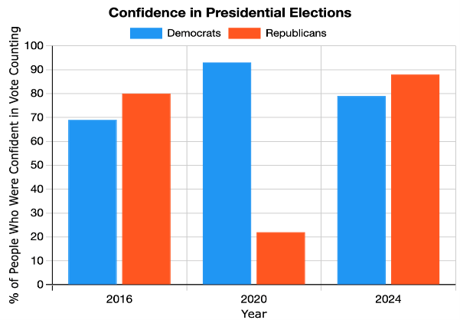
These data suggest that perceptions of election administration are influenced not just by the voting process and the way someone votes, but also by the rhetoric used by various political leaders and election outcomes.
[1] LegalClarity Team, When Did Mail-In Voting Start? From Civil War to Now, LegalClarity (Apr. 1, 2026), https://legalclarity.org/when-did-mail-in-voting-start-in-the-united-states/.
[2] LegalClarity Team, supra note 1
[3]Summary Table 1: States with No-Excuse Absentee Voting, Nat’l Conf. of State Legislatures (June 3, 2026), https://www.ncsl.org/elections-and-campaigns/table-1-states-with-no-excuse-absentee-voting
[4] U.S. Election Assistance Commission, The 2016 Election Administration and Voting Survey Comprehensive Report (Washington, DC: U.S. Election Assistance Commission, 2017).
[5] U.S. Census Bureau, Voting and Registration in the Election of November 2024 tbl. 14, U.S. Census Bureau (May 2023), https://www.census.gov/data/tables/time-series/demo/voting-and-registration/p20-587.html.
[6] Michael P. McDonald, Juliana K. Mucci, Enrijeta Shino & Daniel A. Smith, Mail Voting and Voter Turnout, 23 Election L.J. 1 (2024).
[7] Paul Steinhauser, Republicans Warn Mail-in Voting Rhetoric Could Backfire as Trump Modifies Stance, Fox News (Aug. 7, 2020, 8:54 AM), https://www.foxnews.com/politics/republicans-warn-mail-in-voting-rhetoric-backfire-trump
[8] Caitlin McFall, Trump Calls Mail-In Voting a Scam, Says Democrats Are Setting Up Election “Mess,” Fox News (Sept. 18, 2020, 7:00 PM), https://www.foxnews.com/politics/trump-calls-mail-in-voting-a-scam-says-democrats-are-teeing-up-a-mess
